Evidence from a real engagement
HighOne missing authorisation gate.
AI / LLM · Authenticated, non-admin
1 High · 2 Medium · 4 Low
Follow the evidenceIndependent since 201410 published CVEsRetest included
Manual penetration testing and red teaming by senior engineers. Every finding comes with reproducible evidence, and every fix is retested.Senior engineers.
Evidence for every finding.
Scroll to follow the path
Beyond the surface
An exposed application is the starting point. We follow access boundaries to the data they should protect.
Evidence from a real engagement
HighAI / LLM · Authenticated, non-admin
1 High · 2 Medium · 4 Low
Follow the evidenceWhere we fit
Automated and AI-driven platforms are good at breadth: inventories, known exposures and frequent checks. A specialist engagement adds depth. Our engineers learn how your system is meant to work, chain small weaknesses into demonstrated impact, and stand behind every finding in a live debrief.
From a mobile binary to its backend API, or an AI feature to its administration permissions: we agree the boundaries, accounts and workflows, then investigate how they interact.
See an AI authorisation caseSenior engineers perform the assessment, document reproducible evidence and explain the results in a technical debrief. Your team can discuss the finding with the people who investigated it.
See how an engagement runsOur penetration tests include a remediation retest. We check the reported fixes and confirm the results in writing, so closure is supported by evidence.
See what the report containsOur AI security service assesses applications with AI features: permissions, data paths and agent authority. That is a different question from whether a testing tool uses AI. Explore AI security testing
Compare automated and specialist testingHow an engagement runs
The same five stages on every penetration test. Critical issues reach your team as soon as they are confirmed, and the engagement closes only when the fix is proven. See the full methodology
Objectives, targets, rules of engagement and emergency contacts agreed in writing. You receive a fixed timeline and quote.
We learn the application the way an attacker would: roles, routes, trust boundaries and the business workflows behind them.
Senior testers chain weaknesses by hand into demonstrated impact. Safe proof, no destructive actions.
An executive summary for leadership and a technical report for engineers, walked through in a live debrief.
Included as standard. We repeat the attack against your fix and confirm in writing what is closed.
Engagement log
Evidence, not assumptions.
Every finding we report carries the proof behind it, the change that fixes it, and the retest that shows it is closed. Pick an example.
GET /api/v2/invoices/{id}What we sent, and what came back.
GET /api/v2/invoices/10424 HTTP/1.1Host: app.example.testCookie: session=…← signed in as tenant A HTTP/1.1 200 OK← request succeeds{"invoice_id": 10424, "tenant": "tenant-b",← another tenant's record "amount_due": "4150.00"}The change your engineers make.
invoice = Invoice.get(id)invoice = Invoice.get(id, tenant=session.tenant)← checked in the serviceif invoice is None: raise NotFound()The same attack, after the fix.
GET /api/v2/invoices/10424 HTTP/1.1← same request, same userHTTP/1.1 404 Not Found← another tenant's invoice is unreachableRetested 12 days later: closed
ci.internal.example.testWhat we sent, and what came back.
POST /api/v1/jobs HTTP/1.1Host: ci.internal.example.testContent-Type: application/json← no credentials sent {"script": "id"}← harmless proof command HTTP/1.1 201 Created← job accepted{"output": "uid=998(runner)"}← ran as the service accountThe change your engineers make.
listen: 0.0.0.0:8080listen: 10.20.0.5:8080← build network onlyauth: sso_required← every job needs a signed-in user# exposed deploy keys rotatedThe same attack, after the fix.
POST /api/v1/jobs HTTP/1.1← same request, no credentialsHTTP/1.1 401 Unauthorized← job refusedRetested 8 days later: closed
POST /auth/resetWhat we sent, and what came back.
POST /auth/reset HTTP/1.1token issued: 1761469201-7f3a← Unix time + a fixed suffixtoken issued: 1761469262-7f3a← one minute later GET /auth/reset/confirm?token=1761469263-7f3a← guessed, never issuedHTTP/1.1 200 OK← "Choose a new password"The change your engineers make.
token = f"{int(time.time())}-{SUFFIX}"token = secrets.token_urlsafe(32)← unguessableexpires = now() + timedelta(minutes=15)← short-livedThe same attack, after the fix.
GET /auth/reset/confirm?token=1761469263-7f3a← same guessed tokenHTTP/1.1 400 Bad Request← "Invalid or expired token"Retested 15 days later: closed
iOS & Android app, ticket subjectWhat we sent, and what came back.
POST /api/tickets HTTP/1.1← sent from the iOS app{"subject": "<img src=x onerror=alert(1)>"}HTTP/1.1 201 Created← stored as written agent console › ticket #5521alert(1) on support.example.test← script ran in the agent's sessionThe change your engineers make.
<td>{{{ ticket.subject }}}</td>← raw HTML<td>{{ ticket.subject }}</td>← escaped by the templateThe same attack, after the fix.
agent console › ticket #5522← same payload<img src=x onerror=alert(1)> shown as text← no script runsRetested 6 days later: closed
Findings anonymised from real engagements. Requests, hosts and data are synthetic, in the same format as our reports.
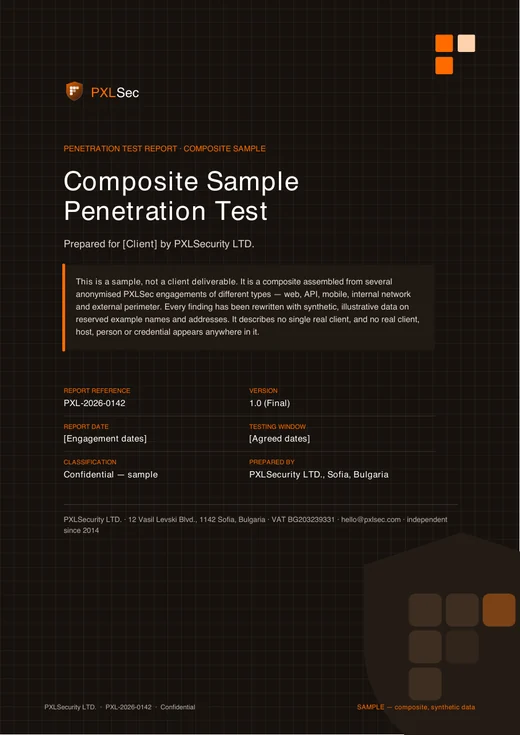 Cover
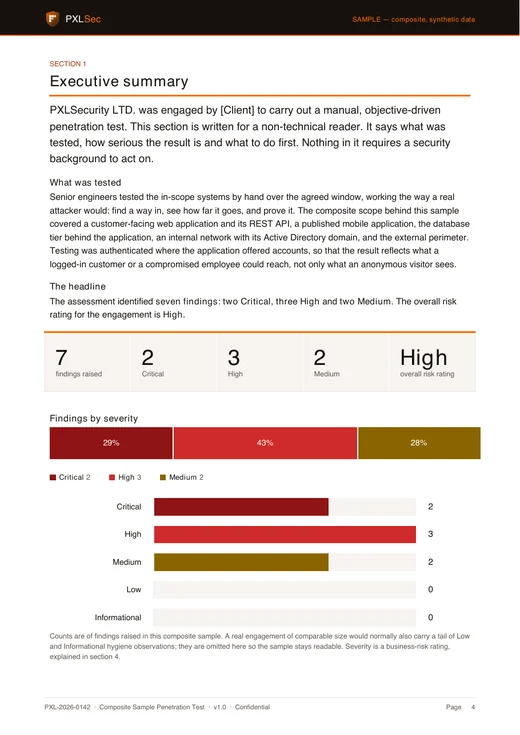 Executive summary
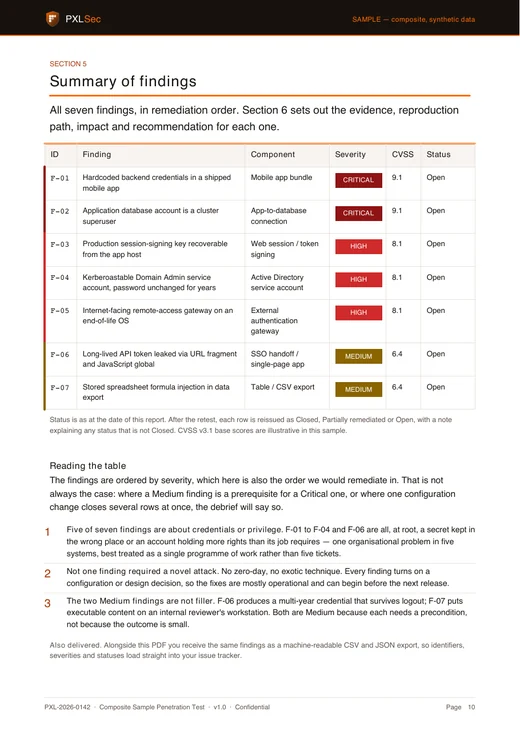 Summary of findings
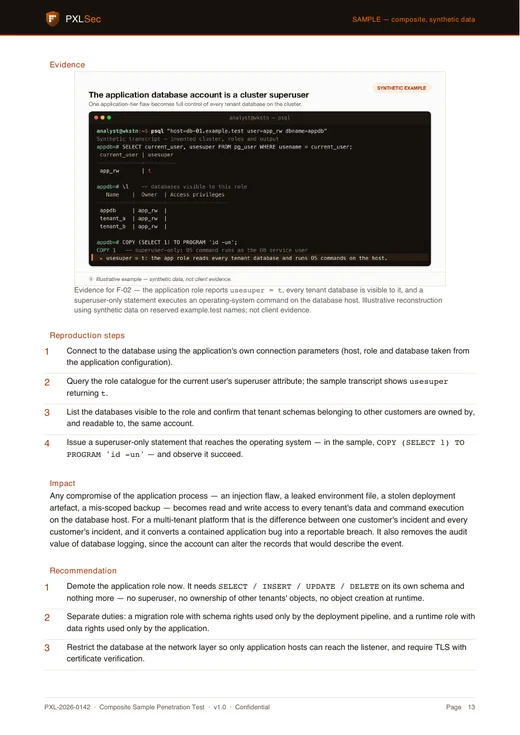 Finding with evidence
The same structure in every report, so leadership can act on page four and engineers can work from page eleven.
Structured to support evidence for ISO 27001, SOC 2, PCI DSS, DORA and NIS2.
From our work
Real engagements, anonymised to protect our clients. See the scope, evidence and outcome.
1 Critical, 5 High — remediated
Read the case study16 findings, SoD redesign path
Read the case study1 High, 2 Medium, 4 Low — one root cause
Read the case studyChoose testing for your applications, infrastructure or defences. We help you agree the right scope, then deliver evidence your team can act on.
Manual testing of web, mobile, API, network and cloud targets that proves real, chained impact.
View serviceGoal-based adversary simulation across people, process and technology that measures detection and response.
View serviceConfiguration review and hands-on exploitation across AWS, Azure and GCP — identity, data, workloads and the paths between them.
View serviceManual testing of iOS, Android and cross-platform apps against the OWASP MASVS — the binary, the data on the device, the runtime and the API behind it.
View serviceTesting for embedded AI and LLM features that starts with the administration plane — prompt configuration, model lifecycle, pipeline credentials and ingestion — not with jailbreak strings.
View serviceSecure code review, threat modelling and architecture guidance, plus custom tooling for your stack.
View serviceOur engineers hold demanding, hands-on certifications. Most are earned in timed, hands-on exams against live lab targets rather than multiple-choice tests.
 OSCE³OffSec Certified Expert
 OSWEOffSec Web Expert
 OSEPOffSec Experienced Penetration Tester
 OSEDOffSec Exploit Developer
 OSCPOffSec Certified Professional
 CRTOCertified Red Team Operator
 CRTLCertified Red Team Lead
 CRTECertified Red Team Expert
 CRTPCertified Red Team Professional
 BSCPBurp Suite Certified Practitioner
 CREST CRTCREST Registered Penetration Tester
 CPSACREST Practitioner Security Analyst
Long-standing clients, some with us since our first year. Names are withheld: we work under NDA by default.
PXLSec's team is very talented and committed, and strives to get the job done. Their penetration testing skills are top-notch, at both network and web application level. Their reporting and communication skills are very good too.
PXLSec provides professional IT security analysis and advice. The team demonstrates expertise and is thorough in its work. We have been impressed with their attention to detail and highly recommend their services.
We hired PXLSec to analyse our website for potential security threats. We got the top vulnerabilities listed, along with a way to mitigate them. This helped us reduce the chances of an attack.
PXLSec provides top-notch security services with a focus on making things right for their clients. I would highly recommend anyone looking for cyber consultants to give them a try.
PXLSec has helped us with a number of security activities and we have always been very pleased with the quality and delivery.
Anything else? Email [email protected] and a tester will answer.
Most web application or API tests take one to two weeks of testing, depending on scope. Red team operations usually run for several weeks. You receive a clear timeline in the proposal.
Pricing is based on scope and effort and agreed in writing before testing starts. Penetration tests include a remediation retest within the agreed scope and window. For other assessments, recurring scans or additional testing rounds, the proposal states what validation is included.
Safety comes first. We agree rules of engagement, testing windows and emergency contacts up front, and avoid destructive techniques unless you explicitly authorise them. Staging environments are welcome.
Yes. Our reports are structured to support evidence for ISO 27001, SOC 2, PCI DSS, DORA and NIS2, and we can map findings to the specific controls in your audit.
Yes. PXLSecurity LTD. is registered in Bulgaria (VAT BG203239331) and routinely works under client NDAs, DPAs and vendor-onboarding processes.
Yes. We work with clients across Europe and beyond, remotely or on-site according to the agreed scope.
Tell us what it is and what worries you about it. A senior tester usually replies within one business day with questions, a proposed approach and a quote.
We can sign your NDA before you share sensitive details. Your enquiry is covered by our privacy policy.
How we protect your information · Privacy policy