Firmware image assessment
You provide the image or update package. We analyse the artefact, investigate the relevant binaries and validate findings using the access available.
Good starting point: a release candidate or a supplier image.
Firmware / Embedded / Product security
Test the firmware you ship and the device that runs it. Reverse engineering, QEMU emulation and hands-on hardware testing, with reproducible findings, practical fixes and an included remediation retest.
Start with an image, a device or a release. NDA available before you share sensitive material.
IMAGE / REVERSE ENGINEERING
Unpack filesystems and binaries. Trace secrets, service configuration and security-sensitive code paths. Separate component matches from verified vulnerabilities.
EMULATION / DYNAMIC ANALYSIS
Emulate supported components or the system where feasible. Instrument execution and validate behaviour; document where peripherals or the environment limit fidelity.
DEVICE / HARDWARE INTERFACES
Inspect UART, JTAG/SWD and flash access as applicable. Test boot, update and runtime boundaries on the agreed devices, with invasive techniques separately authorised.
PRODUCT SECURITY
A key in a filesystem, a shell reachable through a debug port or an update accepted without the right checks can cross very different security boundaries. We investigate what each observation actually permits in your product and deployment.
We combine static analysis, reverse engineering, emulation and testing on real devices according to the target. Source-assisted reviews, device-to-cloud paths and companion applications can be added explicitly. Access to one device does not authorise testing every connected system.
PRODUCT TYPES
From a connected home to a charging station: we scope the firmware, interfaces and trust boundaries of the product you actually ship.
Connected hubs, smart locks, thermostats, switches and sensors. Firmware, onboarding, local control and the trust placed in companion apps or cloud services.
Charge-point firmware, management interfaces, credentials, update mechanisms and charger-to-backend communication, including OCPP where used and in scope.
Routers, access points, firewalls and edge gateways. Embedded services, management access, configuration, updates and device identity.
Industrial IoT gateways, protocol converters and embedded controllers. Device-level firmware and interface testing in an agreed laboratory or representative test environment.
Building-management controllers, HVAC interfaces, connected meters and access-control panels. Local privileges, stored secrets, management protocols and update trust.
IP cameras, recorders, intercoms and readers. Firmware, debug access, authentication, exposed services and the boundaries around recordings or device administration.
Each engagement defines the exact models, hardware revisions and firmware builds. Cloud platforms, mobile apps and wireless protocols are included when agreed; testing a device does not imply authorisation to test a live building, charging network or industrial site.
TESTING SCOPE
Filesystems, native binaries, embedded Linux, bootloaders and security-sensitive application logic. MCU/RTOS targets are scoped by architecture and access.
QEMU-based analysis where feasible, instrumentation and targeted input testing. Findings distinguish emulated behaviour from device-confirmed results.
Signature enforcement, package handling, version/rollback policy and recovery paths. Hardware-rooted claims require appropriate device access and evidence.
Embedded credentials, keys, certificates, device provisioning and the permissions those identities receive.
UART, JTAG/SWD, flash readout and boot configuration, depending on the device. Destructive work is agreed before testing.
Management interfaces, protocols, companion apps and cloud APIs when expressly included in the engagement.
ENGAGEMENT OPTIONS
Choose the access and release decision you need to assess. Each proposal defines targets, methods and deliverables.
Agree the product, builds, attacker starting points, supplied hardware, access and safe test conditions.
Map interfaces and trust boundaries. Unpack, reverse and emulate where useful; record the limitations.
Validate the findings in the available environment and separate demonstrated impact from untested consequences.
Debrief engineering, prioritise remediation and repeat the agreed checks against corrected builds.
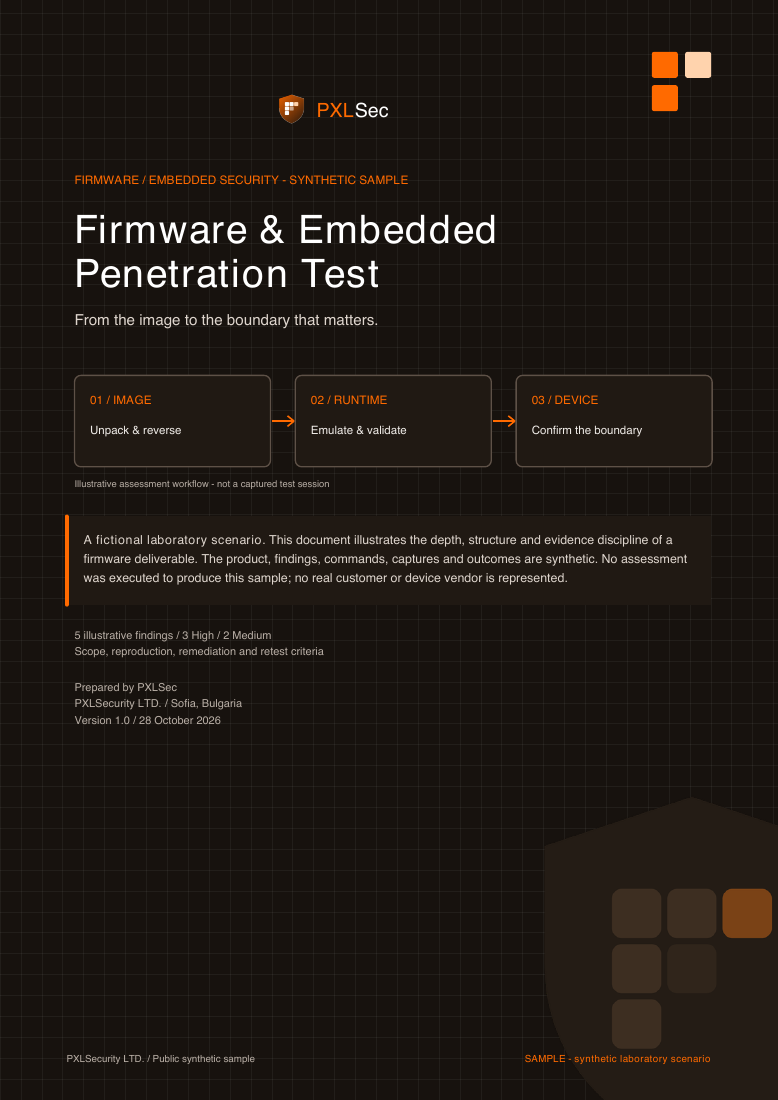
SAMPLE DELIVERABLE / ENGLISH PDF
Request the full illustrative firmware deliverable by email: executive summary, coverage, five detailed findings, remediation and a retest plan. The PDF is in English.
Synthetic laboratory example. Not a real client assessment or an executed test. No actual customer, device vendor or credential is disclosed.
Email me the firmware sampleDELIVERABLES
FAQ
Yes. An image or update package can support filesystem, binary, secrets and configuration analysis. Dynamic validation depends on the architecture, packaging, encryption and available execution environment. We state what an image-only review cannot prove.
Yes, where the architecture, kernel/userspace and peripheral requirements allow useful emulation. We may emulate a process, selected components or a fuller system. Emulation is not a substitute for device validation when the claim depends on hardware or boot configuration.
We can scope extraction through available debug or memory interfaces, boot/recovery paths and board-level work. Success is not assumed. Readout protection, encryption, packaging and destructive access requirements affect the approach.
Some board-level techniques can alter or damage a unit. We agree permitted techniques, expendable units, recovery options and stop conditions in writing. No destructive work is implied by an image assessment.
No. Binary-only and source-assisted engagements are both possible. Source, symbols, build information and documentation can improve coverage; the proposal records what is available.
A baseline followed by agreed releases, change analysis, targeted testing and retest. Product families, release allowance, included effort and response windows are defined; it is not unlimited research or a guarantee that every release is vulnerability-free.
No. The linked English PDF contains a fictional laboratory product and synthetic evidence, marked throughout. It demonstrates report structure and technical depth without claiming a real engagement.
A non-sensitive product description, architecture/OS if known, available images or devices, important interfaces, the testing objective and release deadline. Use the enquiry form for scoping only. We arrange NDA and secure transfer before you send firmware, keys or credentials.
An image, a device or a release programme. We will agree what to test and what evidence you need.
Do not upload firmware, passwords or keys through the public enquiry form. We agree a secure channel and device-handling arrangements.
How we protect your information